What can design do to help us feel safe and secure?
Smart Lockers - Design Options
lockers that are safe, secure and clean
A friend of ours recently shared a webinar with us that he felt would be relevant to our product — both now and as we launch our new endeavor going forward. If you are interested in watching the webinar panel discussion see here.
Here is the description:
In response to our rapidly changing world, IIDA brings you a design-focused dialogue on the effects of a global crisis. Join IIDA Executive Vice President and CEO Cheryl S. Durst, Hon. FIIDA, and a panel of design experts for this important community discussion.
Moderator: Cheryl S. Durst, Hon FIIDA, Executive Vice President and CEO, IIDA, Chicago
Panelists:
Gina Berndt, FIIDA, ASID, Principal, Managing Director, Perkins+Will, Chicago Susan Chang, AIA, Principal and Founder Shimoda Design, Los Angeles Jordan Goldstein, IIDA, FAIA, Principal & Global Director of Design, Washington, DC Tara Headley, Assoc. IIDA, Interior Designer, Hendrick, Atlanta
Later in the video, around the 40:00 mark the moderator asks a very interesting question — What can design do to help us feel safe and secure when we inevitably return to work, school, etc.?
smart materials & reduced touches
Choosing smart materials and reducing the amount of surfaces that patients, employees, students, etc… might come into contact with can help mitigate the transfer of pathogens throughout a building.
Here are a few of the points that we found pertinent and interesting:
The notion of ‘everything’ being a cleanable surface.
The question of will people prefer a design that communicates — it’s clean, it’s safe?
Tactility being important to humans, but how do we balance that need/desire with being safe?
Almost everyone predicts that public spaces will move toward more automation to mitigate contagion, with COVID-19 speeding up development of all types of touchless technology—automatic doors, voice-activated elevators, cellphone-controlled hotel room entry, hands-free light switches and temperature controls, automated luggage bag tags, and advanced airport check-in and security. “I don’t see why if I can tell Siri to call my wife, or my remote to cue up Netflix, I couldn’t tell an elevator to take me to the 10th floor,” says Miami architect Kobi Karp, principal at Kobi Karp Architecture & Interior Design, who has worked on projects for the Four Seasons and 1 Hotels.
Both choosing smart materials and reducing the amount of surfaces that patients, employees, students, etc… might come into contact with can help mitigate the transfer of pathogens throughout a building. There have been a lot of studies about materials, and you want to be looking for seamless materials that don’t have any cracks—that can be easily washed down and don’t react easily to disinfectants—because disinfectants have to sit on surfaces for 10 minutes to do their work.
But the easiest way to keep bacteria and viruses from spreading is to limit how many things patients, workers, students have to touch.
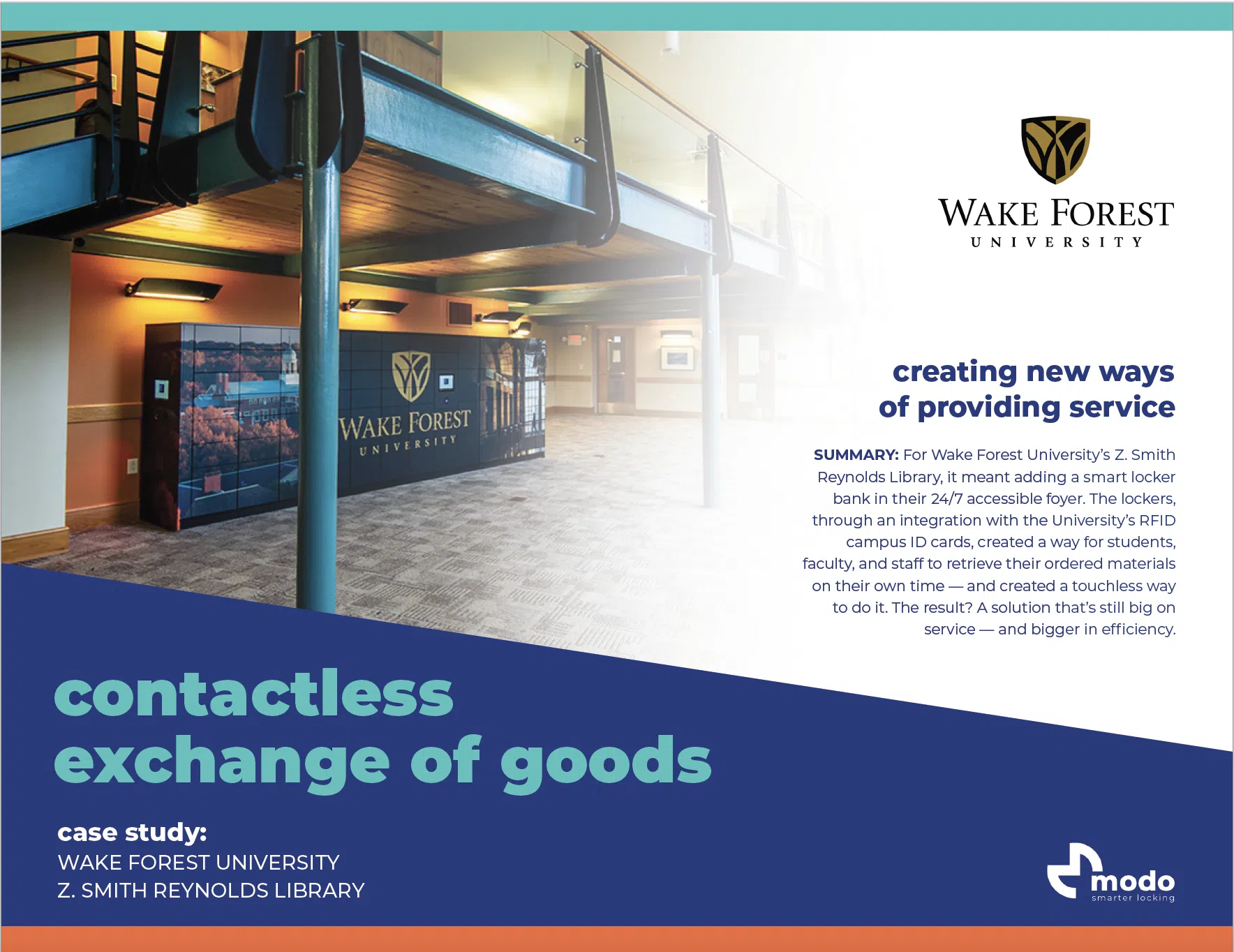
RFID smart lockers
How does Metra Modo help contribute to this new normal?
These insights and thought-provoking conversations got us thinking about lockers and how can we play a part in helping to achieve the first question that was posed — how can design help us feel safe and secure?
Let’s take a look at this aspect of touch-less first. Networked locks are a perfect solution for this type of requirement. By using your phone as your key — you can easily open and/or assign yourself a locker. Or even without your phone you can place your student id or employee badge near the reader and achieve the same result. No need for users to have to touch any dials, buttons or handles and for cleaning its a sleek, flat surface.
Secondarily, the let’s consider the materials. What opportunities are there to enhance the surfaces of the materials that people will touch? Our locks can go on any locker with any material. This means there is opportunity to leverage solid surface materials that can be used for the door of the locker or even laminates with antimicrobial properties. There are plenty of options that will help produce better surfaces or materials to aid in the transfer of pathogens.
And finally, networked lockers provide the ability to schedule cleaning — with full audit capabilities — to give the users of the lockers a peace-of-mind. Something that would be very difficult without networked locks.
Let’s go back to one of the statements in the webinar that people will prefer a design / look that communicates — I’m clean, I’m safe…
Check out these photos and let us know what you think…
Thank you for your interest in learning more about metramodo and metra locks. Please provide your email address and we will deliver your pdf in a jiffy.
download
Thank you for your interest in learning more about metramodo and metra locks. Please provide your email address and we will deliver your pdf in a jiffy.
download
Thank you for your interest in learning more about metramodo and metra locks. Please provide your email address and we will deliver your pdf in a jiffy.