case study
future of the library becomes a reality

How a Library Looks to Provide Top-Level Service with a Contactless Experience
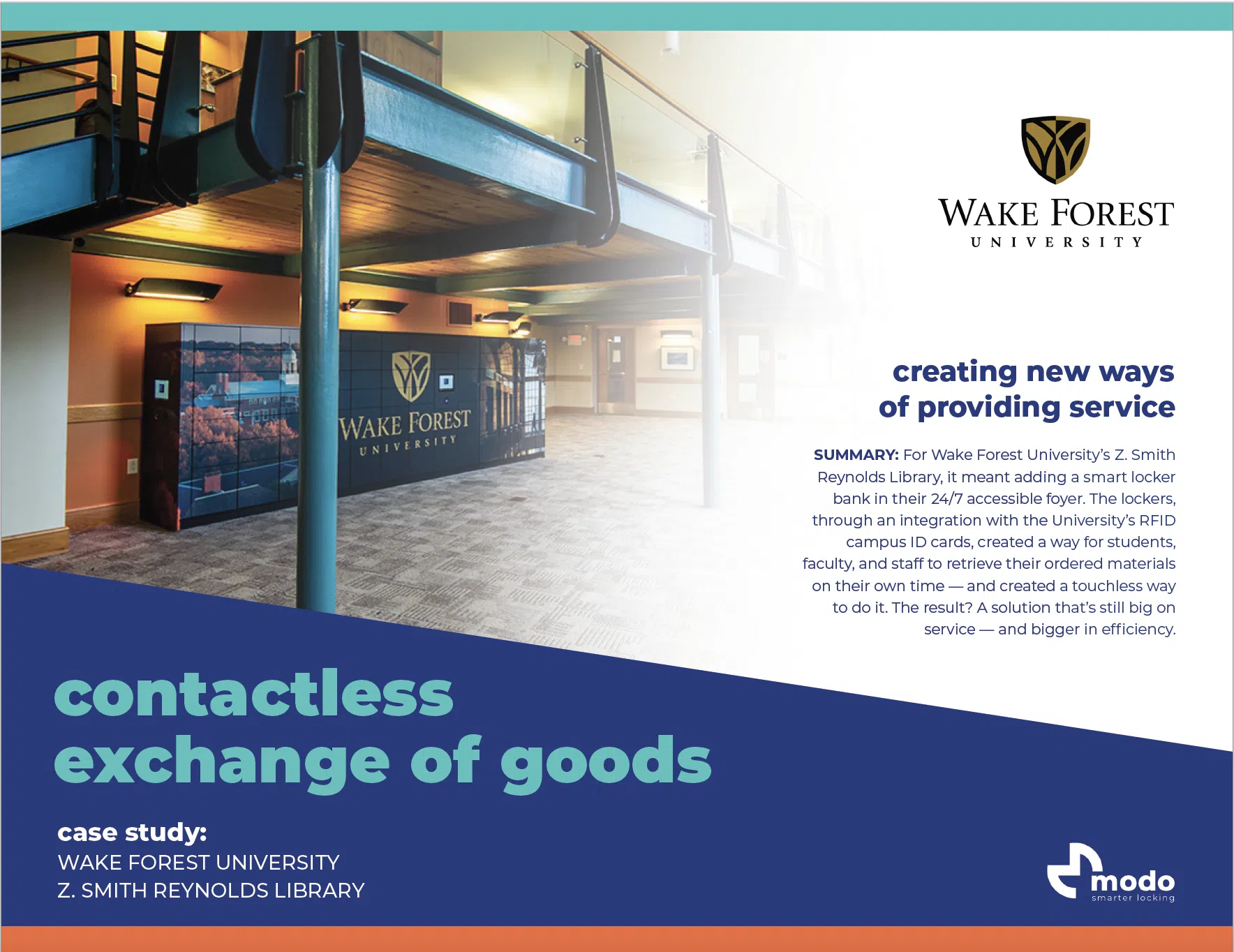
Serving over 8,000 undergraduate students is not an easy task — especially in the midst of a global pandemic. The Z. Smith Reynolds Library (ZSR) at Wake Forest University found itself struggling to provide their quality service while still following COVID-19 protocols. Their initial solution of labeling and filling paper bags with library materials and placing them in the 24-hour foyer was not efficient and only based on the honor system.
The staff at ZSR decided to revisit a conversation about implementing smart lockers that they had prior to the pandemic. When they realized that this “pipe dream” could quickly become a reality, it was a no-brainer to make smart lockers the new solution — and a lasting solution at that.
Technology Integration Adds to Locker Convenience
The smart lockers provide a seamless, contactless experience that allows students, faculty and staff to pick up their library materials at their own convenience. Once an asset is placed in the locker, the locker system automatically sends an email to the student or faculty member. They can then present their school ID card to the reader located on the locker bank and their specific locker will automatically pop open — creating a touch-free experience.

Real-Time Data Gives Insight Into Locker Usage
The smart software gave the ZSR staff insight into how the lockers were being used and realized two things that helped them utilize the lockers to their full potential.
change the configuration on-the-fly
Originally, the lockers were configured for a mix of day-use and exchange of goods lockers — but they knew that they were only utilizing exchange of goods. With the smart software, the configuration of part day-use lockers to 100% exchange of goods was a simple change that was made using the administrative control with just a click of a button.
custom-made lockers
They saw that the lockers were regularly operating at 90% capacity and knew that they needed to add more columns to the locker bank. The extra columns added to the locker banks were an easy addition. The additional lockers were custom-made to accommodate odd-shaped library materials such as tripods and other A/V equipment.